
Men Well-Being
Are We Overdiagnosing Ourselves Through Social Media self diagnosis?
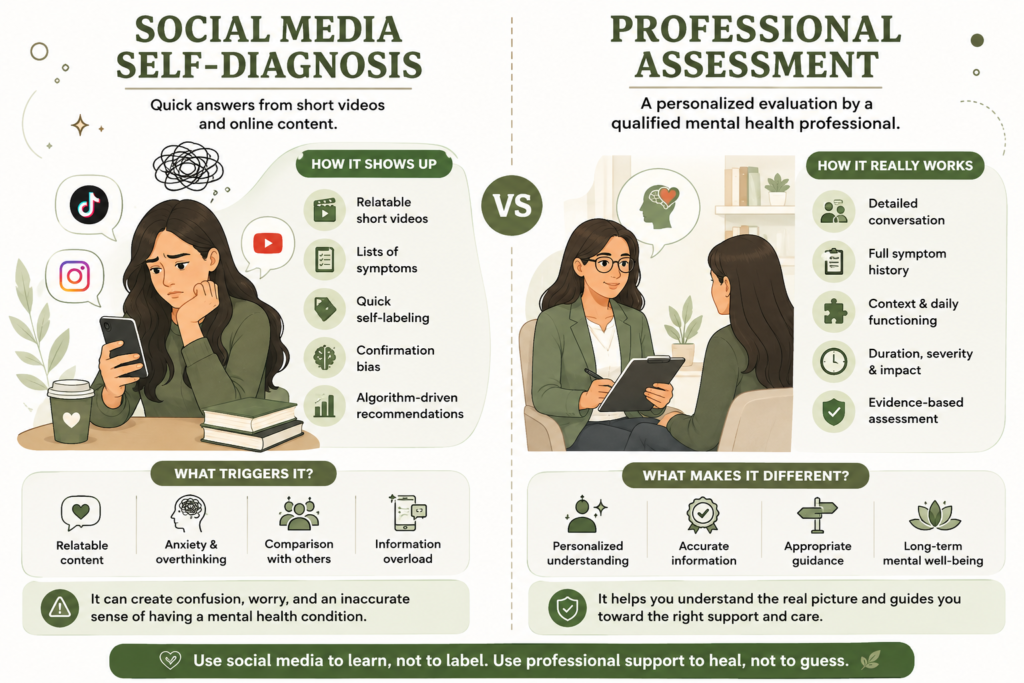
If you have ever watched an Instagram Reel or TikTok about ADHD, anxiety, or OCD and thought, “Wait… I do that too,” you are not alone. Social media has made mental health information easier to access, but it has also made social media self diagnosis increasingly common. Recognizing a relatable symptom can be a useful starting point for learning more about your mental health, but it does not automatically mean you have a mental health disorder. Understanding the difference between a common experience and a clinically significant pattern can help you avoid self-diagnosis of mental health conditions and make more informed decisions about when to seek professional support
In This Article
- What Is Social Media Self-Diagnosis?
- Why Social Media Makes Mental-Health Symptoms Feel Personal
- Why ADHD Is Easy to Self-Diagnose Online
- Why “I’m So OCD” Is Not Always OCD
- When Anxiety Becomes a Mental Health Disorder
- Depression vs. Everyday Sadness
- Symptom vs. Mental Health Disorder: What Is the Difference?
- How a Mental Health Professional Diagnoses a Condition
- How Social Media Can Increase Mental Health Misinformation
- Common Mistakes After Watching Mental Health Content
- How to Use Social Media for Mental Health Information Safely
- When Should You See a Psychologist or Psychiatrist?
- How to Build Healthier Social Media Habits
- Frequently Asked Questions (FAQs)
What Does “Self-Diagnosis” Mean?
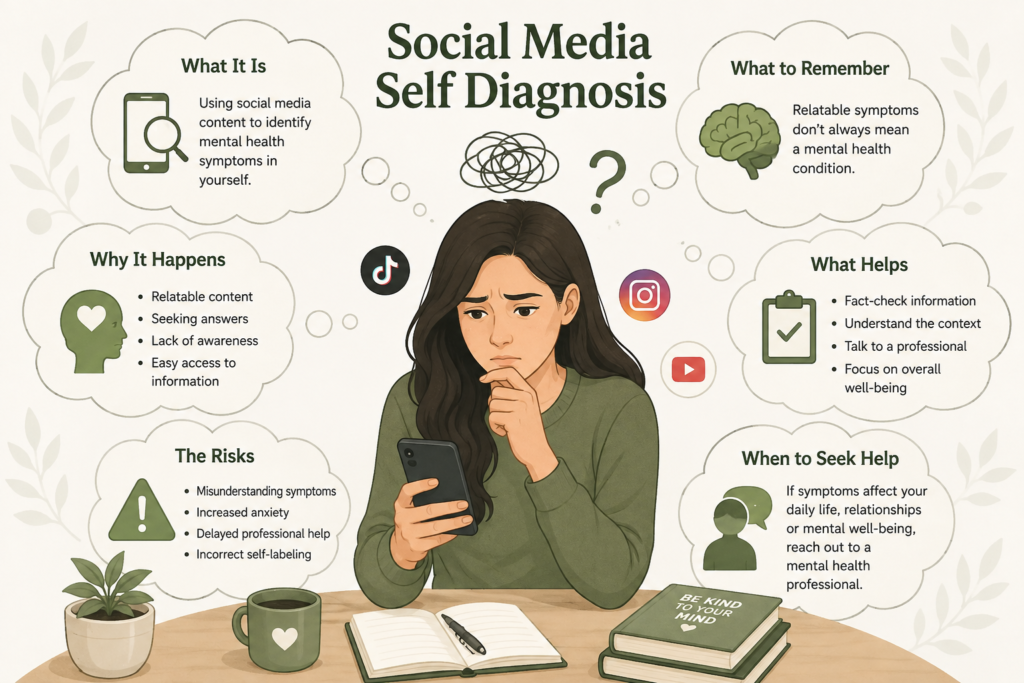
Self-diagnosis is when a person concludes that they have a mental-health condition without receiving a formal assessment from an appropriately qualified professional.
Noticing a pattern in your thoughts, feelings, or behaviour is not wrong. The concern begins when a tentative observation becomes a fixed label without proper assessment.
Self-diagnosis can happen after reading health articles, taking online quizzes, watching videos, or recognizing yourself in another person’s story. These experiences may help you notice something that deserves attention, but they cannot by themselves confirm a mental-health condition.
There is an important difference between recognizing a possible pattern and deciding that you definitely have a specific condition. A professional assessment considers your symptoms, personal history, circumstances, and how they affect your daily life.
How Self-Diagnosis Can Happen
Reading Mental Health Articles
Taking Online Quizzes
Watching Mental Health Videos
Recognizing Yourself in Someone’s Story
Why a 30-Second Mental Health Reel Can Feel So Accurate
It Uses Relatable Mental Health Experiences
Short-form mental health content often mentions common experiences such as forgetting things, procrastinating, losing focus, overthinking, or struggling with boring tasks. Because many people experience these things, a social-media checklist can feel highly specific even when it is not a diagnostic tool.
You Recognize Yourself
When a description seems to match your everyday experiences, your attention naturally increases. This can make social media self-diagnosis feel convincing, particularly when a video connects several familiar symptoms to a mental-health condition.
The Pattern Feels Meaningful
Several familiar experiences appearing together can create the impression that you have discovered an explanation for your behaviour. However, recognizing a mental health symptom is not the same as establishing a mental-health disorder.
A Pattern Can Become a Diagnosis Label
The risk begins when relatable information is treated as proof of a diagnosis without a clinical assessment. This can contribute to ADHD self-diagnosis, anxiety self-diagnosis, or other forms of mental-health self-labeling.
What Research Suggests About Social Media Self-Diagnosis
A 2025 pilot study of 57 young adults entering treatment for mood and anxiety disorders found that everyone in the sample had viewed mental-health content online. Among participants who reported an undiagnosed condition, most said social media contributed to that belief. Because the study was small, its findings should not be generalized to everyone. Another study examining anxiety-related social-media posts found that normalizing anxiety could increase the likelihood of self-diagnosis, with identification with the person in the post helping explain the effect. Together, these findings suggest that online mental health content can become part of the self-diagnosis pathway, while also potentially reducing stigma and increasing mental-health awareness.
Why ADHD Is Especially Easy to Self-Identify With on Social Media
These experiences can occur for many different reasons, which is why an ADHD clinical assessment looks at the broader pattern rather than relying on a social-media checklist. A qualified professional may consider the symptoms, their duration, developmental history, impact on daily functioning or impairment, and whether another explanation fits better. The assessment may also consider symptoms across different settings and relevant diagnostic criteria. A familiar experience by itself is therefore not enough to establish an ADHD diagnosis.
Research illustrates why viewers should be careful with mental health misinformation on social media. One analysis of popular ADHD TikTok videos found that fewer than half of symptom claims in the sampled content were judged to align with DSM criteria. Another 2026 analysis of ADHD content on TikTok and Bilibili found differences in content quality and self-diagnosis risk, with higher-risk content receiving more engagement in that sample. These findings do not mean every ADHD video is misleading; they mean viewers should evaluate the source and the claim rather than treating social-media engagement or virality as evidence of a diagnosis.
The 5 Questions a Clinician Asks During a Mental Health Assessment
A mental health assessment is more like putting together a puzzle than checking boxes on a social-media Reel. Instead of deciding whether one symptom matches a diagnosis, a clinician looks at the bigger pattern, including how long symptoms have been present, how severe they are, how they affect daily life, the situations in which they occur, and whether another explanation may fit. For example, experiences related to stress and anxiety can overlap with symptoms seen in other mental-health conditions.
A clinician may ask when the symptoms started, how often they occur, and whether the pattern has been persistent over time.
The assessment considers how intense, frequent, or difficult to manage the symptoms are rather than simply counting how many symptoms appear on a checklist.
A clinician may explore whether the experience is affecting work, studies, sleep, relationships, responsibilities, or other areas of everyday functioning.
Symptoms can have different meanings depending on the situation. A clinician may ask whether they happen across different settings or only during particular circumstances.
Sleep problems, stress, medication, substances, physical health concerns, or another mental-health condition may sometimes contribute to similar experiences.
7-Day “Less Labeling, More Understanding” Plan
If social media has made you question whether everyday experiences mean you have a mental-health condition, this simple 7-day mental health reset can help you step back from symptom-scrolling, understand your experiences more clearly, and use reliable mental health information instead of relying on self-diagnosis.
Day 1 — Pause Symptom-Scrolling
Stop watching mental-health symptom videos for one evening. Give yourself some distance from social media self-diagnosis and notice how you feel without constantly checking for symptoms.
Day 2 — Describe the Problem
Write down the actual problems affecting your life without using diagnostic labels. Focus on what you are experiencing rather than deciding whether you have ADHD, anxiety, OCD, or another condition.
Day 3 — Track the Pattern
Briefly note your sleep, mood, concentration, and stress. Looking at patterns over time can provide more useful information than matching yourself to a single social-media checklist.
Day 4 — Choose Reliable Information
Read one authoritative mental-health source instead of watching ten short videos. Prefer information from qualified professionals, reputable health organizations, and evidence-based sources.
Day 5 — Talk About Your Experience
Tell someone you trust what you have actually been experiencing. Describe your concerns without assuming that a social-media label is already a diagnosis.
Day 6 — Look at Persistence and Impact
Ask whether the pattern is persistent, distressing, or affecting your work, studies, sleep, relationships, or daily responsibilities. If it is, consider discussing your concerns with a mental-health professional.
Day 7 — Make One Practical Change
Choose one useful next step: book an appointment, improve your sleep routine, establish a healthier daily routine, or reduce social-media content that triggers repeated symptom-checking.
Can social media cause self diagnosis?
Social media can contribute to self-diagnosis by exposing people to symptom lists, personal stories, and diagnostic language. Social media self-diagnosis may feel convincing when common experiences are presented as signs of a specific mental-health condition. Research shows an association between exposure to mental health content on social media and self-diagnostic beliefs, but this does not mean social media causes a mental-health disorder or that every viewer will self-diagnose. Use social media for mental health awareness and education, not as a substitute for professional assessment.
Can Instagram make me think I have ADHD?
Yes. ADHD content on Instagram and other social media platforms can make common experiences such as procrastination, forgetfulness, distractibility, or difficulty concentrating feel highly specific to you. Research has found variation in the accuracy of ADHD content and associations between viewing such content and perceptions of ADHD. If you recognize yourself in an ADHD video, use it as a reason to ask questions rather than as evidence for ADHD self-diagnosis.
Is self-diagnosis of mental illness accurate?
Mental health self-diagnosis can sometimes help a person recognize that something is wrong and motivate them to seek professional support, but it cannot reliably replace a clinical assessment. A qualified mental-health professional considers the full symptom pattern, including duration, severity, impairment, context, developmental history where relevant, and possible alternative explanations.
Why do I relate to every mental-health Reel?
Mental-health Reels often describe broad and common experiences such as overthinking, tiredness, distraction, worry, procrastination, or difficulty sleeping. Because these experiences can occur for many reasons, it is possible to recognize yourself in the same mental health content repeatedly. Relating to a symptom is a reason to explore what you are experiencing, not proof that you have a mental-health disorder.
Does liking a clean room mean I have OCD?
No. Liking cleanliness, organization, symmetry, or having a preference for things being arranged in a particular way does not automatically mean you have OCD. Obsessive-compulsive disorder involves obsessions, compulsions, or both, with symptoms that can be distressing, difficult to control, time-consuming, or impairing. A social-media checklist cannot establish an OCD diagnosis.
Should I stop watching mental-health content?
Not necessarily. Mental health content on social media can increase awareness, reduce stigma, and help people recognize that they may want to seek support. However, prefer information from qualified professionals, reputable health organizations, and credible sources. Be cautious of accounts that diagnose viewers, promote unsupported treatments, promise instant cures, or use fear and certainty to drive engagement.
When should I see a psychologist or psychiatrist?
Consider speaking with a psychologist, psychiatrist, or other qualified mental-health professional when symptoms are persistent, recurrent, distressing, or interfering with work, studies, relationships, sleep, or everyday functioning. You do not need to wait until the problem becomes severe, and you do not need to arrive with a self-diagnosis. You can simply describe what you have been experiencing.
Can lifestyle changes treat mental-health problems?
Healthy sleep, regular movement, balanced nutrition, supportive relationships, and stress-management practices can support mental health and emotional wellbeing, but they are not universal cures for mental-health disorders. When a clinical condition is present, evidence-based treatment may be needed. Lifestyle changes should support appropriate care rather than replace a professional mental-health assessment when one is needed.
